Interview with William Kroll, Owner and Founder of Tender Co.
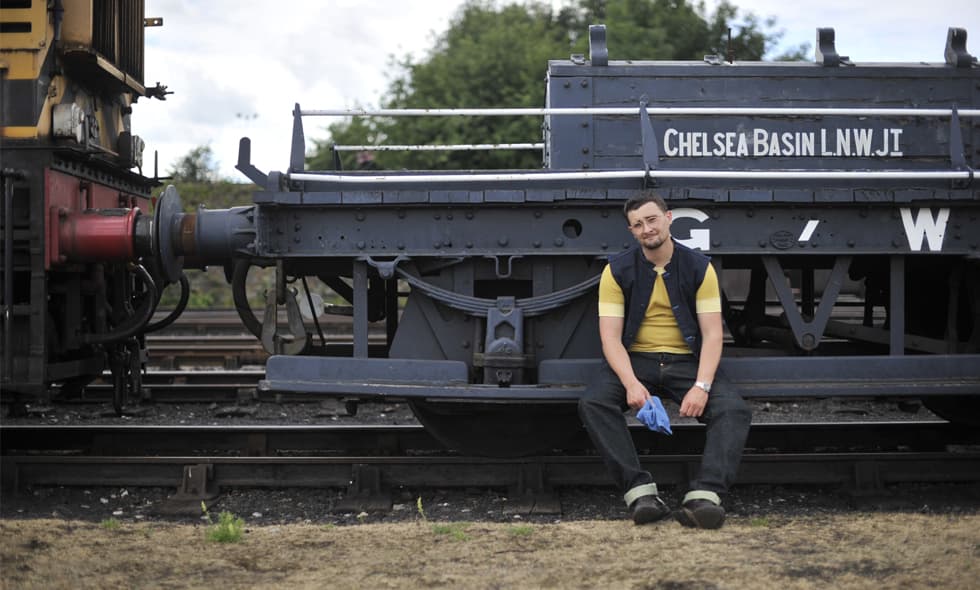
William Kroll is the man behind Tender Co , a small clothing label that specialises in denim and making products by hand. Inspired by antique workwear and machinery, Tender gets its name from the stream train, a tender was the truck which carried the coal and water to power the locomotive.
I couldn’t wait to interview William and extract some knowledge from his brain, I knew he would have some intriguing things to say, and luckily for us he didn’t disappoint.
You can see us converse below.
What made you want to start TENDER? What’s the inspiration behind it all?
I’ve loved the craft of constructing clothes since I made my first pair of jeans out of heavy upholstery canvas when I was 14. At college I got really interested in tailoring, and spent a year learning Savile Row coatmaking with John Coggin, who taught me a huge amount about the technical aspects of hand-made clothes, but also the history and stories of the trade, and how clothes came to be the way they are.
After graduating, and working as a jeans designer for a few years, I took a couple of months’ break in Japan, learning hand dyeing with an indigo master in Okayama Prefecture, the home of Japanese denim. The level of commitment to skill and craft there is something that people often talk about, but learning first hand from someone like that was truly amazing!
So Tender really came about as a combination of my excitement about making jeans, historical clothing ideas and techniques, and the idea of the patience, skill, and subtlety required in hand-dyeing with natural colours.
Denim of course is essentially a work cloth, so I also brought in references to British work clothing, specifically from the steam railways- the name Tender refers to the coal and water transporting truck on a steam train, coupled between the engine and the carriages. I like how the word also evokes care and love, as well as the concept of tending to something- bringing it up, looking after it, improving it, as a gardener tends a flowerbed, or a shepherd tends his sheep…
You’ve got some really nice explanations on your website about the processes and the different elements of what goes into your designs. Could you explain these to our readers?
I’d like to think that Tender’s clothes are accessible at different levels- if a garment really needs explanation or instructions for it to be enjoyed then it’s not quite right in some respect. You should be able to enjoy a shirt or a pair of jeans at face value, because of the texture of the fabric, the feel of the hardware, the way it looks.
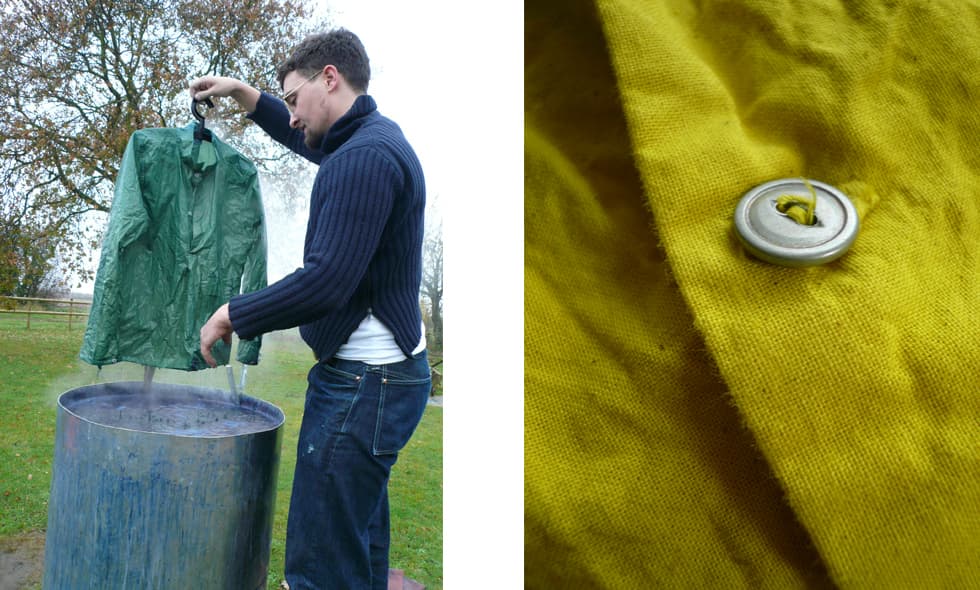
However for me the fun really starts when you begin to go below that level, both in the garment’s construction and its references: hopefully the shirt’s an interesting fit and an especially rich colour, but I think it’s made more interesting if you know that it’s cut from an adaptation of a 17th Century pattern, across a single piece of English-woven calico, so that the selvages of the cloth form the front and back hems, that the cuffs are inspired by those on 19th Century railway workers’ blouses, and that the yellow colour is hand dyed with Weld, a plant extract which was mixed with woad to form the green worn by Robin Hood.
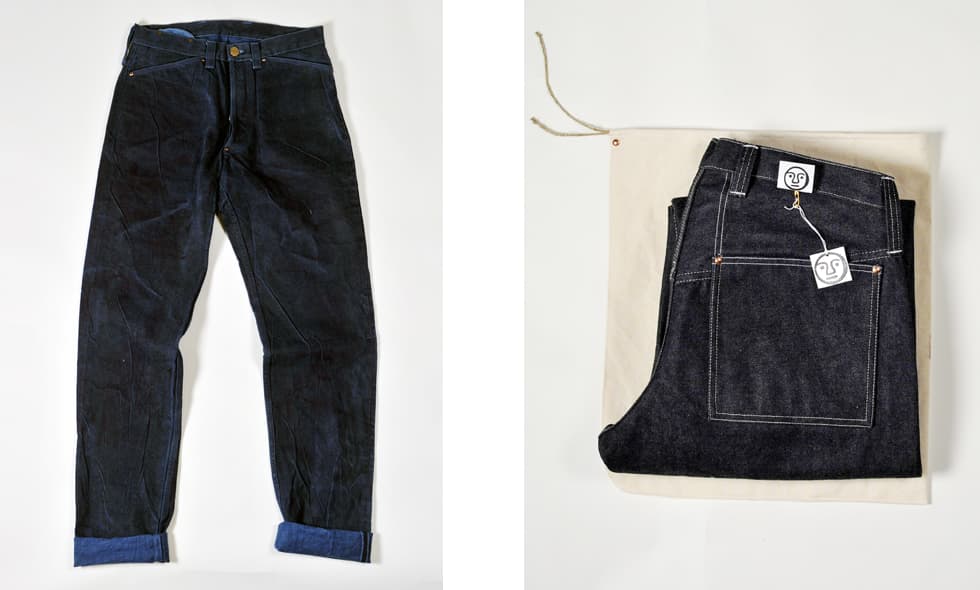
Another reason for explaining the stories behind Tender’s things is that they are designed to improve with wear, getting better and more personal as the fabrics soften, the seams get repaired, the hardware tarnishes. The side pockets on Tender jeans are cut straight, across the diagonal (the bias) of the fabric. I find that ‘scoop’ pockets, the standard jeans side pocket, can be a bit tight to get into, and eventually give and break- by cutting the pockets straight on the bias, the pocket mouth with stretch out pretty soon, with wear, creating a 3D curve, personal to the wearer and much more comfortable and practical. This kind of thing isn’t evident when you look at the jeans on a shelf though, so it needs a bit of explaining.
Have you always had a passion for Denim and Workwear related products? If so, why do you think you were drawn to it?
I love the simplicity and openness of denim design. When you’re making a tailored garment you have linings which you can hide mess behind. The Savile Row mantra ‘clean on the outside, dirty on the inside’ sums that up: a tailored garment is all about shaping from behind- the fabric you see is really just a smooth attractive skin for the engineering underneath.
With jeans construction (which I think of as applying to anything made in the same philosophy as jeans) there’s nowhere to hide. Jeans seams are basically the same on the inside and outside, and if you sewn on a pocket, you’ll see the stitches behind the pocket- there’s no front-of-house/backstage, in the way that there is with a lot of other clothing.
I once went to an exhibition of Shaker design- Shaker furniture is beautifully simple and economically constructed, and aesthetically I really love the way it looks. But I read that the Shakers believe that as God is omniscient, he can see inside the joints of a chair just as well as he can see how smooth a table top has been planed, so even the parts of furniture that will never be seen by human eye after their construction are just as important as the silhouette and outside surfaces.
I find that way of thinking about things amazing, and there’s a certain parallel in jeans design, I think.
Why is history so important to you and your brand? You really delve into the origins of each product that you make.
I just think there’s such a lot of wonderful stuff out there to be rediscovered! But I’m keen that Tender doesn’t become a strict ‘repro’ brand. There are other people out there doing that so well, that I don’t think I’d be able to bring anything much to add- what I’m interested in doing is looking at the kind of clothing that wouldn’t necessarily be wearable today as strict reproduction, but taking ideas from it, reevaluating how and why things were done, and working back to a new garment that maybe isn’t even recognisable from the original(s), but which share some common thought processes, and is interesting and wearable.
I know you have a keen eye for detail, and you’re very knowledgeable about the clothing trade and how garments are made. Why do you think a lot of men are dissecting brands more these days and are choosing quality over quantity?
There’s such a lot of choice out there, and so much of it is so good, that men buying clothes are getting more and more educated and particular about what they’re spending their money on. There’s also an interest in provenance and quality, which I think is really positive. Personally I’ve always liked to buy things which will last- physically, but also stylistically and personally. I still wear stuff I got when I was a teenager.
I guess in the end, ‘buy quality once’!
“ So Tender really came about as a combination of my excitement about making jeans, historical clothing ideas and techniques …
How does it feel to actually make your own product, to produce something totally from scratch? Basically a creation that wouldn’t exist otherwise.
It’s amazing! It was (and still is) really exciting spotting things I’d designed in my previous job worn on the streets, but Tender really is my own project from scratch, and knowing that people out there are enjoying what I do, and spending their money on it, is great. It’s all still small enough that for every pair of Tender jeans that’s out there, I know that I personally fixed on the cast brass buttons myself, I was the one who pinned on the swing-tag. That’s a very nice feeling.
Could you explain a little bit behind the logo and what relation that has to the whole concept?
My grandfather was a graphic designer, and I inherited some wonderful books from him, including a book of 19th Century advertising art. The elephant label comes from an ad encouraging men to leave for Nevada, for the Gold Rush. The text inside read “SEVEN-LEAGUE-BOOTS EXPRESS! DIRECT TO NEVADA THE LAND OF ROCKS OF SILVER Streaks of Gold MOUNTAINS OF COPPER, MINES OF SULPHUR. Hie! Ye Penniless, Hie! To Plautus’s Treasury.“
The story of jeans starts with the Gold Rush, and the work clothing that was made for the prospectors, so it seemed like an appropriate place to begin. Within the text of the original sits a little circular, expressionless, face. I don’t know what this means, or why it was put there, but it’s become the logo for Tender, and it’s cast into the buttons, rather like a signet ring. I like to think that it’s Plautus, looking on skeptically.
One thing that really intrigued me was the way in which you work with small collectives. How did you go about finding all these people to handle each separate part of the process?
I’ve been lucky enough to meet some incredibly skilled people, some have been introduced through friends, others have been pretty much by chance- the fantastic tannery that oak-bark tans the leather for Tender’s belts and bags is in the town where my grandma lives.
I’m always on the lookout for interesting producers though, and these smaller factories and crafts people have been really generous with their time and effort, as I’m still learning a huge amount.
“ With Tender, I not only sketch out every idea over and over again, but I also wear prototype designs long enough to really decide if they’re how they should be.
How hands on are you with your own product?
Very! I make all the patterns and prototypes myself, on my little domestic sewing machine. This allows me to work through everything stitch by stitch, before going over everything in great detail with the people who sew the finished pieces.
When you work on larger scale production you have to leave a lot of small details up to the factory, so you don’t always have full control over how something turns out. With Tender, I not only sketch out every idea over and over again, but I also wear prototype designs long enough to really decide if they’re how they should be.
When it comes to production, it’s still a matter of writing out the style numbers on the washing tabs by hand, and packing the production up into suitcases to bring home on the train… Every pair of jeans and jacket comes with a little note from me, handing it over to its new owner. Things like that may be silly, in a way, but I think it’s important for the customer to know that these products have come from someone who really cares about them.
What’s the most satisfactory thing about owning your own label?
Being able to come out with exactly the product that I want to, and which I feel makes sense for Tender, and is technically appropriate, without, at this stage, having to compromise due to production schedules, development budgets, that kind of thing. It’s far more work than I ever thought possible, but to be able to wear my own clothes, and to hear from people who are enjoying them too, is a great reward.
Are there any downsides to being located in England? Also, can you think of any specific problems that you had when starting TENDER?
I’ve been really lucky so far, in that I’m working with great people, on production and in shops. There aren’t that many manufacturers for a lot of the kind of thing I’m doing left in this country, so it can be a struggle getting things done, but actually I rather like the challenge of working within the capabilities of certain machinery- early workwear was totally designed around it’s production limitations. A big advantage of being in the country where production happens is that it’s really easy to pop down to see factories if anything needs looking at, it’s an hour’s train ride away, not 9 hours on a plane.
Where does all your knowledge come from? Let’s face it, what you do is quite niche …
I’m really interested in what I do, so ideas come up from all over the place, and I find that I’ll remember things I read years ago, or saw in an exhibition somewhere, long after I thought I’d forgotten them.
It’s also a lot about talking to people- I always love meeting anyone who really knows about something. You can often learn more about clothing in half an hour over a cup of tea with a retired tailor than you can in months of fashion shows and research in museums (although they’re both good too!)
What would you say to other individuals who want to make their own product? Any words of wisdom?
I don’t really feel I’m far enough down the road to have any particularly wise words yet… but I do think it’s extremely important to be making something that’s special, and different from what else is out there in some way.
There’s so much that’s already great that it can be quite daunting, but as long as you’re doing something for the right reasons I think anything’s possible!
What’s next for TENDER?
At the moment I’m getting into the production of the third season, which is fun, and also starting out on the design for the fourth season, so it’s a lovely part of the year.
For the moment there’s no grand plan, I’m just concentrating on bringing in more interesting ideas, and allowing Tender to grow into a fuller collection without losing the depth that I work hard to get into each product.
Many thanks to William Kroll for taking time out of his schedule to answer these questions.
The above imagery is a mixed batch featuring William in the first image and the last image dying a garment, and two pairs of Tender denim. Check out the Tender Co. website by clicking the link below.
“I love the simplicity and openness of denim design. When you’re making a tailored garment you have linings which you can hide mess behind.”